
Hampden County Court Records After Arrest
A Hampden County arrest can start with Springfield, Chicopee, Holyoke, Westfield, Palmer, state police, or another local agency. If the person is committed to sheriff custody, booking and intake may occur at the Hampden County Correctional Center in Ludlow or, for women in county custody, at the Western Massachusetts Regional Women's Correctional Center in Chicopee. That jail record explains custody. The court record begins when the criminal case is opened in the Massachusetts Trial Court and the Hampden District Attorney's Office files or prosecutes the charge.
The useful split is custody record versus court record. Booking records can show who was received, which legal paper caused custody, and whether a hold blocks release. Court records after a jail arrest show the case number, charge text, court events, bail orders, docket entries, and disposition. For current custody and booking detail, use Hampden County jail inmate records. For booking photos, use the separate Hampden County jail mugshots page because court dockets do not serve as a mugshot gallery.
Hampden County court records after a jail arrest often move quickly at first. A new case may show an arraignment, a bail decision, a continued date, or a warrant return before the full charge history is easy to read. The jail may still hold the person while a clerk docket, a mittimus, a warrant, or another hold is reviewed.
Search Hampden County Court Records
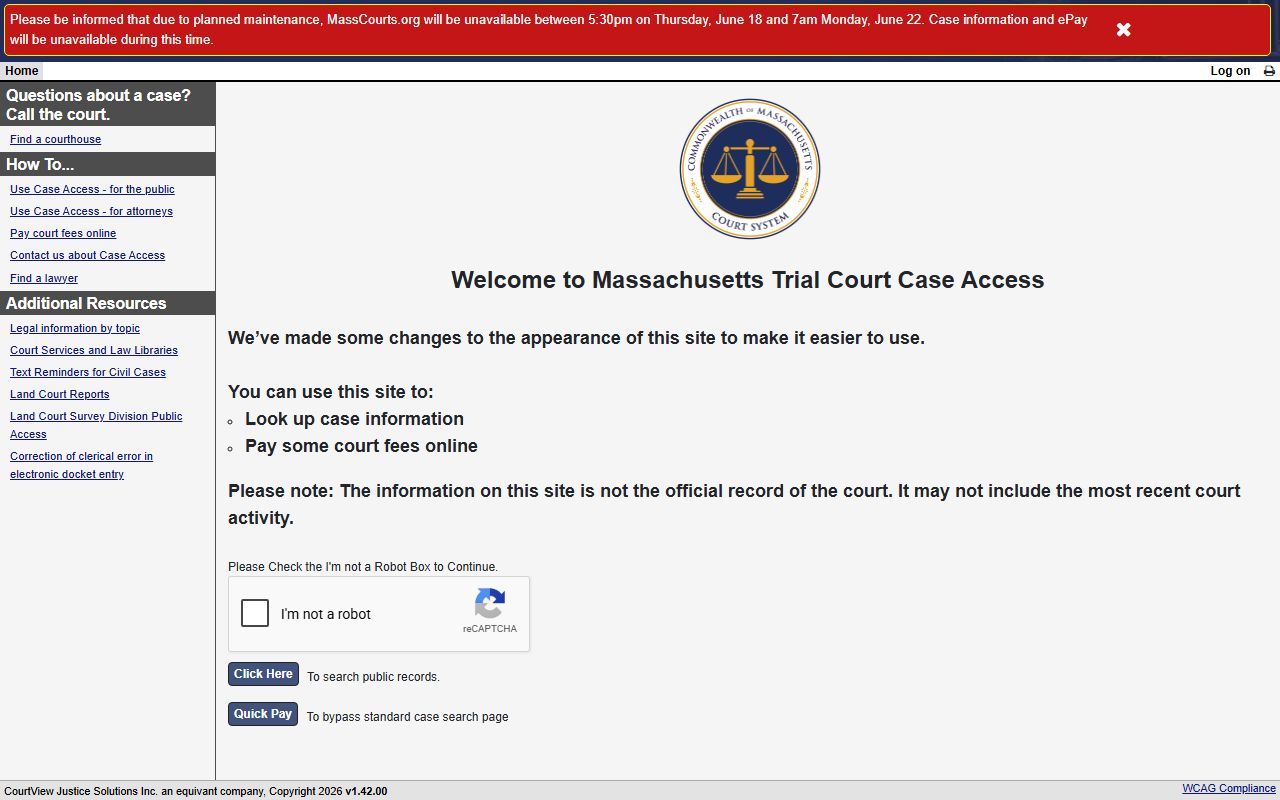
The primary public search channel is MassCourts public case access. Mass.gov's court dockets and case information guidance says public users can search dockets, calendars, and case information for Massachusetts Trial Court matters. Its docket-search instructions describe party, event, docket, and disposition details. Criminal name search can be limited, so a case number, ticket number, court location, or arraignment date can be more useful than a broad name search.
MassCourts is the case-search tool, not a jail roster. A person may be booked before all court data appears in a public search. If a clerk's office has not processed the case yet, use the likely court location, arrest date, and defendant name to narrow the search. Springfield cases often use the Hall of Justice at 50 State Street, while district court matters may be in Chicopee, Holyoke, Palmer, or Westfield based on the arrest location and charge.
| MassCourts field | Type | Required | How it helps |
|---|---|---|---|
| Name tab | Search path | Varies | Useful where name search is allowed for the case type. |
| Case Type tab | Search path | Varies | Filters by court department, case type, and date range. |
| Case Number tab | Search path | No, but best if known | Most direct way to reach a known docket. |
| Ticket/Citation tab | Search path | Only for citation matters | Helps with traffic or citation-linked criminal cases. |
| Court department/location | Dropdown | Varies | Select the relevant Hampden Trial Court location when prompted. |
| Date range | Date fields | Varies | Use the arrest, arraignment, or filing range when name search is limited. |
The MassCourts case-access screen is the right public starting point for many Hampden County court records after a jail arrest. The screenshot is from MassCourts public case access.
Use the docket details with care. A pending charge is an accusation until the case has a final disposition.
Hampden County Arrest Charge Records
The Hampden District Attorney's Office is the county prosecutor. Anthony D. Gulluni is the Hampden District Attorney, and the Mass.gov location record lists the office at 50 State Street, Springfield, MA 01103, phone 413-747-1000, with public hours Monday-Friday 8:30 a.m.-5 p.m. The DA site states that the office prosecutes cases in Hampden County in District Court, Superior Court, and Juvenile Court, with a State Police Detective Unit assigned to assist investigations.
The DA's role does not make the DA office the source for certified court records. The DA's public-records guidance says certified court records must be obtained from the appropriate district or superior court clerk. DA records may include investigation or prosecution files, but those records can be redacted or withheld for ongoing prosecutions, CORI limits, juvenile matters, privacy, grand jury material, medical records, sexual assault or domestic violence reports, attorney work product, and other exemptions.
The Hampden DA public-records page is still useful for prosecution-record requests. The screenshot is from the Hampden DA public-records request guidance.
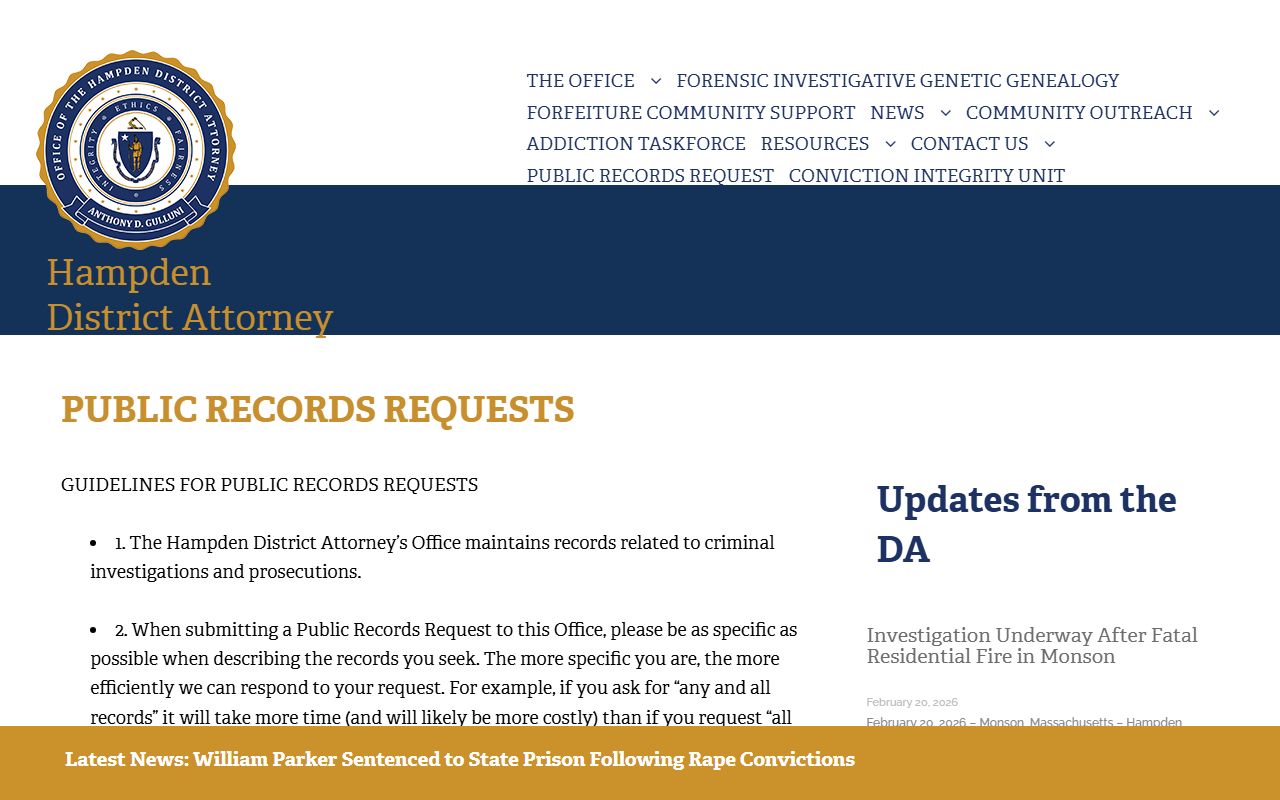
A narrow request with the defendant name, docket number, arrest date, and requested record type is more practical than an open-ended request for all records.
Hampden County Court Records Locations
Hampden County court records after a jail arrest may be tied to more than one courthouse. The DA lists the Hall of Justice at 50 State Street in Springfield, Chicopee District Court at 30 Church Street, Holyoke District Court at 20 Court Plaza, Palmer District Court at 235 Sykes Street, and Westfield District Court at 224 Elm Street. Juvenile matters may involve Springfield Juvenile Court at 80 State Street or Holyoke Juvenile Court at 121 Elm Street, but juvenile delinquency records have stronger access limits.
| Court or office | Address | Common use |
|---|---|---|
| Hall of Justice | 50 State Street, Springfield, MA 01102 | Major Springfield court hub and Superior Court access point. |
| Chicopee District Court | 30 Church Street, Chicopee, MA 01020 | District Court cases from the Chicopee area. |
| Holyoke District Court | 20 Court Plaza, Holyoke, MA 01040 | District Court cases from the Holyoke area. |
| Palmer District Court | 235 Sykes Street, Palmer, MA 01069 | District Court cases from eastern Hampden communities. |
| Westfield District Court | 224 Elm Street, Westfield, MA 01085 | District Court cases from Westfield and nearby towns. |
| Juvenile courts | Springfield and Holyoke locations | Juvenile cases, usually with restricted public access. |
Hampden County Charging Records
After a Hampden County arrest, the first booking label may not be the final court charge. Massachusetts criminal cases often begin in District Court with a complaint. More serious matters can move to Superior Court through an indictment returned by a grand jury. The research did not identify a Massachusetts criminal-information process as the standard path for these Hampden County cases, so information is best understood as a prosecutor-filed charging paper in systems that use it, not the usual local starting point.
| Document | Who uses or files it | Common Massachusetts context | What to check |
|---|---|---|---|
| Complaint | District Court process, often tied to police and prosecutor review | Starts many District Court criminal cases after arrest or application. | Charge text, docket number, arraignment, bail, next event. |
| Information | Prosecutor-filed charge in jurisdictions that use that route | Not the main Hampden County path identified in the research. | Whether the local court docket actually uses this label. |
| Indictment | Grand jury, prosecuted in Superior Court | Used for serious felony cases that move beyond District Court. | Indictment count, Superior Court docket, arraignment, bail, status. |
Charges may be amended, reduced, dismissed, or indicted after the first court date. That is why court records after a jail arrest should be checked by docket status, not just by the original booking label.
Hampden County Court Charge Status
Charge status is the current posture of an accusation. A docket can show pending events, arraignment, continuances, dismissal, nolle prosequi, guilty findings, not guilty findings, probation, commitment, sentencing, or continued without a finding. A jail record can lag behind or summarize the custody basis, while the court docket is the better source for filed charge status and disposition.
| Status | Plain meaning | Why it matters |
|---|---|---|
| Pending | The charge is still active and not finally resolved. | Future court dates, bail, and conditions may still apply. |
| Arraigned | The charge was formally read and the case entered court. | Bail or release conditions are often set here. |
| Continued | The case was moved to a later event or date. | No final outcome has been reached. |
| Amended or reduced | The filed charge changed from an earlier version. | The docket may differ from the booking charge. |
| Dismissed | The charge was ended without a conviction on that count. | Sealing or expungement questions may follow. |
| Nolle prosequi | The prosecutor declined to continue that charge. | The case may end or continue on other counts. |
| Guilty or sentenced | A plea or finding resulted in conviction and sentence. | Custody may shift from HCSO to MADOC if a state-prison sentence is imposed. |
Hampden County Court Bail Holds
Massachusetts bail is governed in part by M.G.L. c. 276, Section 58, which covers personal recognizance and bail decisions. HCSO's local bail-release pages explain what happens at the facility after bail is set. At the Main Institution, a person who wants to post bail uses the bail phone in the Public Lobby to reach the Intake Supervisor, or the Central Control Room Supervisor on weekends. The supervisor checks for any other legal hold before release.
Hampden County jail release can stop even when a bail amount is paid. HCSO says another legal hold means the person will not be released. Holds can include warrants, detainers, another mittimus, unclear court paperwork, probation issues, or agency holds. If the mittimus requires ELMO, meaning electronic monitoring, HCSO holds the person and transports them to the next court session or probation department unless another active hold prevents that process.
| Release term | Meaning in the local process |
|---|---|
| Personal recognizance | Release on a promise to appear, without cash bail. |
| Bail amount | Money set to assure court appearance. |
| Mittimus | Court commitment or custody paper reviewed before release. |
| Legal hold | Another warrant, detainer, order, or agency basis that blocks release. |
| ELMO | Electronic monitoring condition that can require court or probation handling before release. |
Local release caution: HCSO says personal checks and money orders are not accepted for bail, and a person with an active no-contact restraining order against the inmate may not receive the released person.
Hampden County Arrest Warrant Records
No HCSO active warrant search, sheriff most-wanted database, or countywide warrant app was located in the official research. Warrants tied to a court case are handled through court records, clerk offices, police channels, and public-records requests. A bench or default warrant may appear in a docket after a missed court date. An arrest warrant may be tied to a complaint or indictment. A fugitive warrant or out-of-county hold can keep a person in HCSO custody after local bail is addressed.
The absence of a public warrant page is not proof that no warrant exists. Use MassCourts by docket number where possible, call or visit the relevant clerk, or speak with defense counsel before surrendering. If an arrest has already occurred, the jail release review may reveal whether another warrant, detainer, or agency hold blocks release.
Hampden County Charges Versus Convictions
Hampden County court records after a jail arrest may show serious accusations before any finding has been made. A charge means the government has accused the defendant. A conviction means there has been a guilty plea, guilty finding, or other final result that counts as a conviction. The distinction matters for employment, housing, licensing, immigration, and reputation, but those uses may require formal, compliant background-check procedures rather than casual docket searches.
| Question | Charge | Conviction |
|---|---|---|
| Stage | Filed accusation after arrest or warrant. | Final guilty result by plea or finding. |
| Proof level | Based on charging standards and probable cause. | Requires proof beyond a reasonable doubt or a valid plea. |
| Docket effect | May remain pending, change, or be dismissed. | Creates sentencing, probation, commitment, or other final entries. |
| Custody link | Can support bail, holds, or pretrial detention. | Can lead to a house-of-correction or state-prison sentence. |
Hampden County Sealed Court Records
Massachusetts access rules include public-records law, CORI rules, and court sealing or expungement processes. M.G.L. c. 6, Section 167 defines CORI terms, and M.G.L. c. 6, Section 172 governs access and dissemination of CORI. Court-record access may narrow when a record is sealed, expunged, juvenile, or otherwise restricted.
| Issue | Sealed | Expunged |
|---|---|---|
| Public visibility | Hidden from most public access. | Treated more like the record should not exist in ordinary access. |
| Record status | The record remains but access is limited. | The record may be destroyed or erased as allowed by law. |
| Who may see it | Some courts, agencies, or authorized users may still have access. | Access is more limited and depends on the order and statute. |
| Best source | Clerk, court sealing resources, or DCJIS/CORI channels. | Clerk, court expungement process, or qualified legal counsel. |
Sealing or expungement can affect court and CORI access, but it should not be treated as an automatic removal of all copies that may already exist outside the court system.
Restricted Hampden Court Records After Arrest
Public access starts with M.G.L. c. 66, Section 10 and the public-record definition in M.G.L. c. 4, Section 7, clause 26. Access is not absolute. Hampden DA guidance lists limits for ongoing investigations or prosecutions, personal identifying information, grand jury material, attorney work product, medical or autopsy records, juvenile delinquency, CORI, sexual assault and domestic violence reports, and personnel files.
Those exemptions explain why two people can find different parts of the same arrest-to-court trail. A clerk may provide a docket, while the DA redacts investigation records. A juvenile matter may not appear in the same way as an adult case. A booking record may exist at HCSO, while the court record has only the formal charge and disposition. Note: Certified court records come from the clerk, not from the DA public-records office.
Important: Public docket searches are not consumer reports and should not be used for employment, credit, insurance, tenant screening, or other FCRA-covered decisions.